How Google AI Mode Is Changing SEO in 2026: The Complete Guide for Businesses
Introduction
Alongside the technology, Search Engine Optimisation has also evolved. User experience, mobile-first loading, and keyword stuffing are the major updates that forced marketers to rethink their strategies
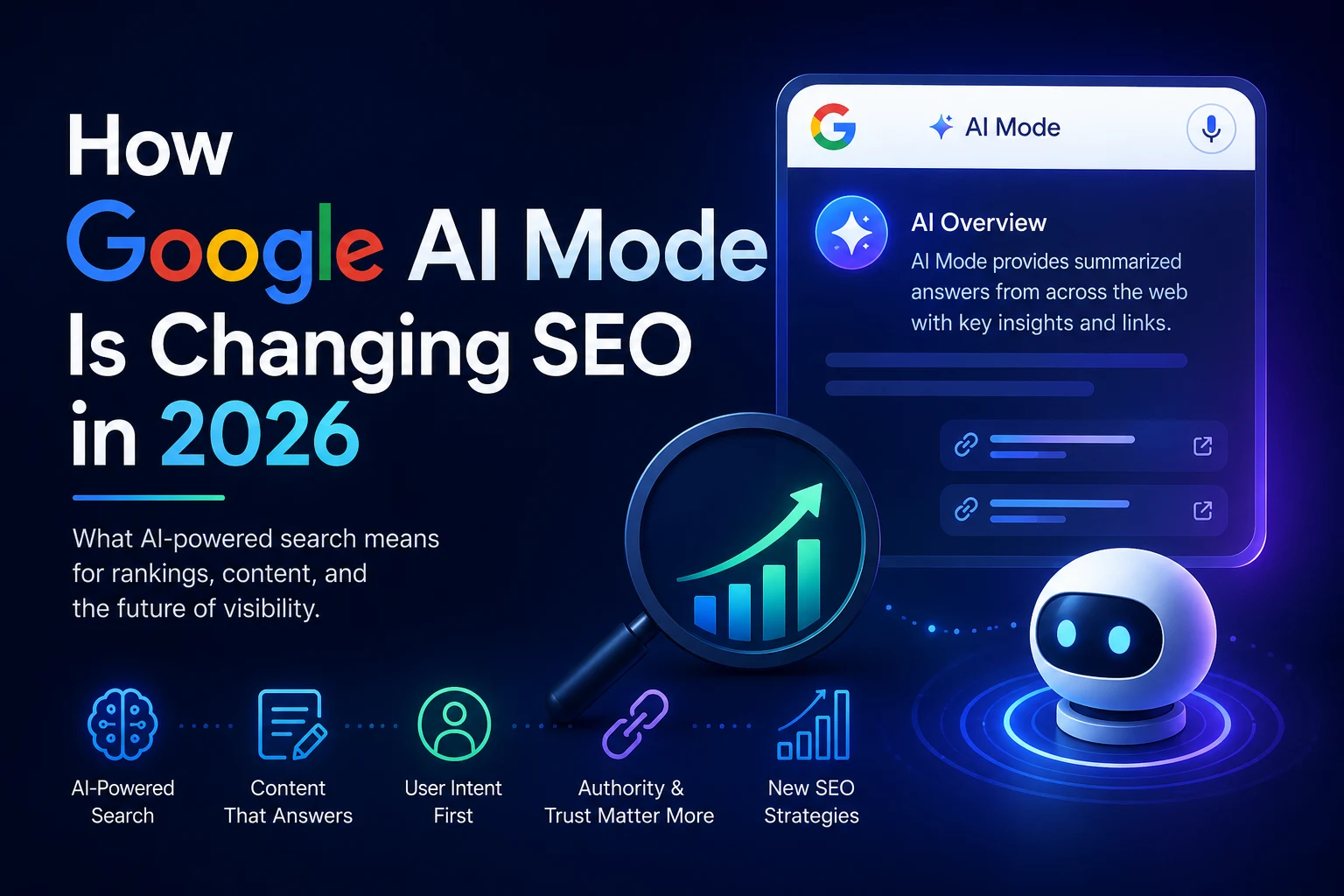
Google AI Mode, powered by Google Gemini models, is the biggest transformation to arrive in 2026. Google AI Mode modifies the fundamental ways people search, interact with websites, and discover information. Instead of showing users a list of blue links, search is becoming more conversational, contextual, and answer-focused
For marketers & business owners, the major update denotes that ranking no 1 is no longer the only goal. The new challenge is becoming a trusted source that AI systems choose to reference and cite. This blog elaborates on Google AI Mode, how it impacts SEO in 2026, and best practices to stay visible in the era of an AI-Powered world
What Is Google AI Mode?
Google AI Mode is a conversational search model developed by Google. It allows users to ask questions, receive AI-generated responses and pursue follow-up queries within the search interface
Unlike in a traditional search method, the user types a short query and browses multiple websites, and Google AI Mode generates the consolidated answers from multiple sources of information.
For example, instead of searching
best smartphones under ₹30,000
A user might ask:
• What are the best smartphones under ₹30,000 for photography?
• Which one has the best battery life?
• Compare the top two options
The AI understands the context and gives the recommendations instantly. As per Google’s latest information, more than one billion users have surpassed this conversational search mode, which illustrates how quickly it is becoming mainstream.
How Google AI Mode Differs from Traditional Search
The traditional search method only focuses on the SERPs – optimising the webpages to rank higher in search engines.
Path: Search query -> Search result -> Website click -> Information
With Google AI Mode :
Search query -> AI-generated response ->follow-up conversations -> Selective website visit
This shift has a larger impact on users because they are getting the answers instantly without shifting the website.
Here is a comparison:
| Traditional Search | Google AI Mode |
|---|---|
| Keyword-based | Intent-based |
| Ten blue links | AI-generated responses |
| Single query | Multi-turn conversations |
| Ranking-focused | Citation-focused |
| Click-centric | Answer-centric |
| Static results | Personalized results |
Google AI Mode continues to evolve, and businesses that love experimenting and continuous learning have a long-term advantage. Regularly, search behaviour, intent, user expectations and formats are changing, making flexibility the essential key for success. Periodically analyse your search data, monitoring the new AI features and refining your content strategy based on the user’s search intent and engagement patterns. By combining strong technical SEO, authentic expertise, and effective AI search optimisation, brands can maintain visibility, build trust, and stay competitive in the future of SEO.
The Rise of Zero-Click Searches
Google AI Mode is one of the biggest consequences of the growth of zero-click searches
A zero-click search occurs when users get the information they need directly on the search page without visiting another website.
AI-generated answers significantly increase the probability of these interactions. Recent research indicates that AI-generated search results can reduce traffic to informational websites by approximately 15%, with some industries experiencing even larger declines.
This does not mean SEO is dead.
It means success metrics are changing.
Instead of focusing only on:
- Organic traffic
- Rankings
- Click-through rates
Businesses must also measure:
- Brand visibility
- AI citations
- Brand mentions
- Assisted conversions
- Branded searches
In 2026, visibility matters as much as clicks
Why Generative Engine Optimisation (GEO) Matters
As AI search evolves, a new discipline is emerging: Generative Engine Optimisation (GEO).
Generative Engine Optimisation (GEO) focuses on improving your content so that AI systems can understand, trust, and cite it in their generated answers
Traditional SEO asks
"How do I rank higher?"
GEO asks:
"How do I become the source AI references?"
This requires a different approach to content creation.
Instead of publishing dozens of short articles targeting similar keywords, brands should create comprehensive, authoritative resources that answer user questions thoroughly.
How AI Chooses Sources?
While Google's algorithms remain proprietary, research suggests that AI-generated search experiences use citation patterns that differ significantly from traditional rankings. Many cited sources do not appear among the top organic results.
AI systems evaluate factors such as:
- Topical authority
- Content quality
- Expertise
- Trustworthiness
- Structured data
- Contextual relevance
- User intent alignment
This means smaller brands can compete with larger competitors if they consistently produce high-quality content.
Why E-E-A-T Is More Important Than Ever?
Google continues to emphasise Experience, Expertise, Authoritativeness, and Trustworthiness (E-E-A-T).
In the era of AI-powered search, these signals have become essential.
AI systems prefer content that demonstrates.
- First-hand experience
- Industry expertise
- Accurate information
- Transparent authorship
- Credible sources
To strengthen your E-E-A-T, consider:
- Publishing expert-written content
- Including author biographies
- Adding case studies and original research
- Citing reputable sources
- Displaying customer testimonials
- Maintaining updated content
Generic AI-generated content without real expertise is becoming less effective.
Optimize for Topics, Not Just Keywords:
Traditional SEO often focused on individual keywords
Modern AI search optimization prioritizes topic depth and semantic relevance.
Instead of creating separate articles for:
- Best CRM software
- Affordable CRM software
- CRM software for small businesses
Create a comprehensive pillar page that addresses all related questions
AI systems prefer content that covers a subject holistically because it provides richer context.
This strategy helps establish topical authority and increases your chances of appearing in AI-generated responses.
Create Content for Conversational Search:
Users interact with Google AI Mode differently from traditional search.
Queries are becoming longer and more natural
Examples include:
- "What is the best way to improve local SEO for a small business?"
- "How can manufacturers generate leads using digital marketing?"
- "What are the benefits of email automation for B2B companies?"
To optimize for conversational search:
- Use question-based headings
- Answer specific user concerns
- Write naturally
- Include FAQs
- Cover follow-up questions
Think about how people speak, not just how they type.
Structured Data Is Essential:
Schema markup helps search engines understand your content.
As AI search becomes more sophisticated, structured data becomes increasingly valuable.
Focus on implementing:
- Article schema
- FAQ schema
- Organization schema
- Product schema
- Review schema
- Local business schema
Structured data improves context, which helps AI systems identify reliable information.
Technical SEO Still Matters:
Despite all the excitement around AI, the fundamentals of SEO remain critical.
Your website must still be:
- Fast-loading
- Mobile-friendly
- Secure (HTTPS)
- Easy to crawl
- Easy to index
Google has confirmed that strong SEO fundamentals remain essential for visibility in AI experiences
Technical issues can prevent AI systems from discovering and understanding your content.
Do not neglect:
- Internal linking
- XML sitemaps
- Core Web Vitals
- Canonical tags
- Crawl optimization
The Rise of Search Everywhere Optimization.
Consumers no longer search exclusively on Google.
Today, they discover information through:
- AI assistants
- Video platform
- Social media
- Online communities
- Marketplaces
This trend is known as Search Everywhere Optimization
Your content strategy should extend beyond your website
Consider creating:
- YouTube videos
- LinkedIn posts
- Social media content
- Podcasts
- Community discussions
The stronger your digital presence across multiple channels, the more likely AI systems are to recognize your brand authority.
Build a Recognizable Brand:
Brand authority is becoming a major competitive advantage.
AI systems increasingly favor well-known, trusted brands.
To strengthen your brand presence:
- Develop a unique point of view
- Publish original research
- Encourage customer reviews
- Build thought leadership
- Increase branded searches
People trust brands they recognize—and AI systems often do too.
Key Metrics to Track in 2026:
As SEO in 2026 evolves, marketers need new performance indicators.
Track:
- AI citations
- Brand mentions
- Branded search volume
- Engagement metrics
- Conversion rates
- Customer lifetime value
- Customer lifetime value
Traffic remains important, but it is no longer the only measure of success
Common SEO Mistakes to Avoid:
As businesses adapt to Google AI Mode, avoid these common mistakes:
- Publishing low-quality AI-generated content
- Prioritising keyword density over user intent
- Ignoring technical SEO
- Creating thin, repetitive articles
- Neglecting brand building
- Failing to demonstrate expertise
The era of mass-produced content is ending.
Quality, trust, and originality matter more than ever.
The Future of SEO Is Human-Centered:
Although AI is transforming search, one principle remains unchanged:
Create content for people.
Google consistently emphasizes delivering helpful, trustworthy information to users. AI systems are designed to reward content that solves real problems and provides genuine value.
Businesses that focus on user experience, expertise, and authenticity will continue to succeed
SEO is not disappearing.
It is evolving.
The future belongs to brands that combine human expertise with AI-friendly optimization strategies.
Final Thoughts
Google AI Mode is reshaping the search landscape faster than any previous update.
The transition from rankings to citations, from keywords to conversations, and from clicks to visibility marks a new era for digital marketing.
To succeed with SEO in 2026, businesses should focus on:
- Building topical authority
- Strengthening E-E-A-T
- Optimizing for conversational search
- Implementing structured data
- Expanding beyond traditional search channels
- Measuring brand visibility alongside traffic
The goal is no longer just to rank.
The goal is to become the trusted source that AI chooses to recommend.
Brands that adapt early to AI search optimization and Generative Engine Optimization (GEO) will gain a significant competitive advantage in the years ahead.